Why DICOM Still Frustrates Interventional Cardiologists – And What to Do About It
June 3, 2025“It’s not the complexity of the procedure that slows me down — it’s waiting for the images to load.”
— Dr. Anil Mehta, Interventional Cardiologist, Mumbai
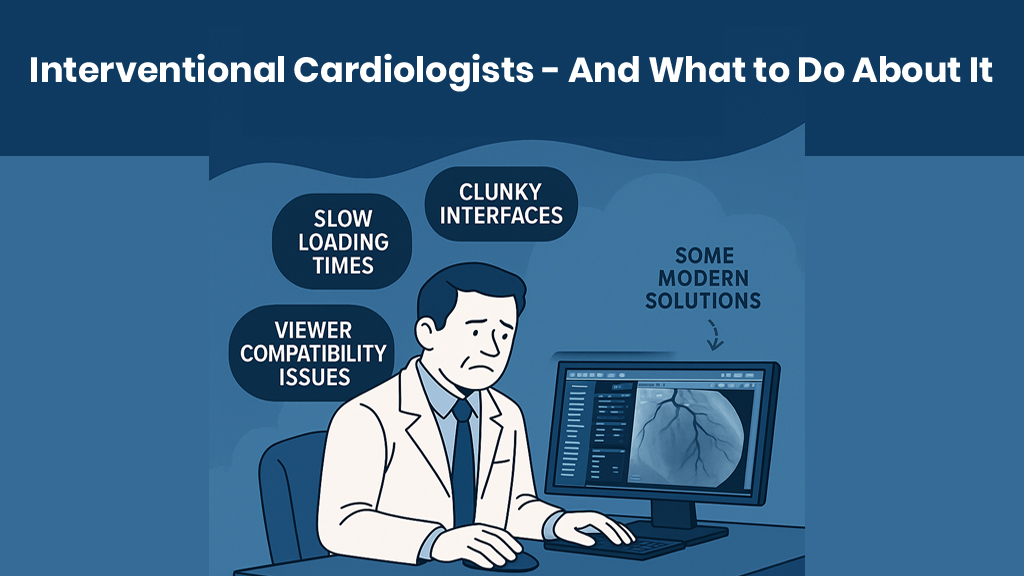
For a specialty as time-sensitive and image-dependent as interventional cardiology, it’s surprising how much frustration still lingers around something as fundamental as viewing DICOM images. Despite technological progress, many cardiologists continue to encounter clunky interfaces, long load times and incompatibility between viewing systems — even in modern catheterization labs.
The Daily Struggles with DICOM
Imagine a typical day in the cath lab. You’ve just completed a complex PCI, and now it’s time to review the angiogram to plan next steps or prepare for a case conference. But instead of diving straight into analysis:
- You wait for images to load on a PACS system that wasn’t built with speed in mind.
- The system requires software installation — but your workstation isn’t configured for it.
- You try to access the files remotely, only to find they’re in a format not supported by your device.
- Collaboration with a colleague in another hospital becomes a game of email ping-pong and external drives.
These delays and inefficiencies aren’t just annoying — they can impact decision-making, disrupt workflow, and increase the cognitive load during already intense clinical routines.
Real-World Case: The File That Couldn’t Travel
Dr. Priya Shah, an interventionist from Delhi, shared her experience of preparing for a high-risk CTO case. The patient had previously undergone imaging at another center, but the files were on a CD that wouldn’t open on her PACS viewer due to an outdated format. “We ended up repeating the angiogram just to get what should have been instantly accessible,” she said. “That’s not just a waste of time — it’s a risk to the patient.”
What’s Behind These Persistent Issues?
Most problems with DICOM viewing stem from:
- Legacy systems that haven’t evolved with clinical needs.
- Lack of standardization across hospitals, vendors and devices.
- Over-reliance on bulky software that limits portability and flexibility.
- Minimal consideration for the specific needs of interventional cardiologists, who require speed, clarity and the ability to collaborate instantly.
What Can Be Done?
The good news: modern solutions are emerging that address many of these pain points.
- Lightweight, portable viewers that don’t require installation are now making it easier to plug in, view and share DICOM cases from any Windows-based system.
- Some plug-and-play tools come with storage capacities tailored for high-volume users, allowing clinicians to carry thousands of DICOM files without needing network access.
- Newer tools enable quick export of images and videos to universally viewable formats like JPEG or AVI, simplifying case presentations or referrals.
- Features like password protection and offline viewing bring both security and convenience to the table — especially useful in multi-institutional or outreach settings.
Explore how some of these modern solutions are shaping a smoother imaging experience for cardiologists:
👉 Efficient, Portable, and Secure: Why This DICOM Solution Is a Must-Have for Interventional Specialists
Closing Thoughts
As interventional cardiology advances in precision and complexity, your imaging tools should evolve too. While some of the old frustrations with DICOM persist, the path forward is increasingly clear: faster, more flexible and clinician-focused viewing experiences.
🔹 Are your DICOM tools working for you — or making your job harder?
🔹 What features do you wish your current DICOM viewer had?
🔹 Have you explored portable or plug-and-play options that could streamline your day?
0 Comments